 The Lantern
A Greek city that produced an Olympic victor set up his statue at home as well as at Olympia, and the bronze went on standing for him in the marketplace long after he was dead. The city of Thasos, an island off the coast of Thrace, had the most decorated athlete that antiquity counted: Theagenes, a boxer and pancratiast of the 480s and 470s BC, who by Pausanias's reckoning won some 1,400 crowns. The Thasians said that his real father was Heracles, who had visited his mother in the likeness of her husband, a priest of Heracles. When he was nine, walking home from school, he took a fancy to the bronze statue of a god in the marketplace and carried it home on his shoulder. The citizens wanted to kill him for it, and an elderly man of standing persuaded them to let him carry it back instead.
The jealous athlete of the familiar story is Theagenes's enemy, but the first jealousy recorded against his name is his own. At the games of 480 BC he entered both the boxing and the all-in fighting of the pancratium, apparently in order to beat Euthymus of Locri, the reigning boxing champion; he did beat him, but was too exhausted to fight the pancratium. The umpires, deciding that he had entered the boxing only to spite Euthymus, fined him a talent payable to the god and another to Euthymus, and he did not box at Olympia again. He went to Phthia in Thessaly and won the long footrace, because, Pausanias thought, it was the country of Achilles, the swiftest of the heroes. A poet of the third century BC made one of his statues speak about his appetite: he had eaten a Thracian bull by himself, "And, therefore, here you see, I stand in brass, Holding my right hand forth; put something in it."
The statue in Thasos had a stranger career. After Theagenes died, one of his enemies came to it every night and flogged the bronze, "as if it were Theagenes alive he was maltreating", until one night it fell on him and killed him. His sons prosecuted the statue for murder. The Thasians found it guilty and threw it into the sea, following, Pausanias says, "the code of Draco, who in legislating for the Athenians banished even inanimate things if they killed anyone by falling upon him". At Athens a court still sat for such cases in his day, trying "iron and other inanimate things": once a year it tried the axe used at an ancient sacrifice of an ox, and every year the axe was acquitted. To the Greeks a killing polluted the city whether the killer had a mind or not, and the pollution had to go somewhere.
Then the crops failed on Thasos. The Thasians sent to Delphi, and the god told them to recall their exiles, which they did, and the famine went on. They went back to say that they had obeyed and the gods were still angry, and the priestess answered: "Your great Theagenes you have forgotten." Nobody knew how to recover a bronze from the bottom of the sea, until some fishermen caught it in their net. The Thasians put it back on its base and sacrificed to it as to a god. By Pausanias's time there were statues of Theagenes in many parts of Greece and among foreigners too, and people went to them to be cured of illness.
The rival had an afterlife of his own. Euthymus, Pausanias was told, went home to Italy and came to Temesa, a town that every year gave its most beautiful girl as a bride to the ghost of one of Odysseus's sailors, stoned there for raping a local girl on the way home from Troy. Euthymus saw the girl, pitied her, fell in love with her, and fought the ghost, which "dived into the sea and was never seen again". He married her, and Pausanias had heard that he lived to a great age and "did not die, but left mankind some other way". He had also seen a copy of an old painting of the story, in which the ghost was "dreadfully swarthy and most formidable in all his appearance, and dressed in a wolfskin", and labelled with his name, Lycas.
Today's picture: A young boxer with his hand-straps, inside of a red-figure cup, c. 490-480 BC. (Photo: Mark Landon, CC BY 4.0.)
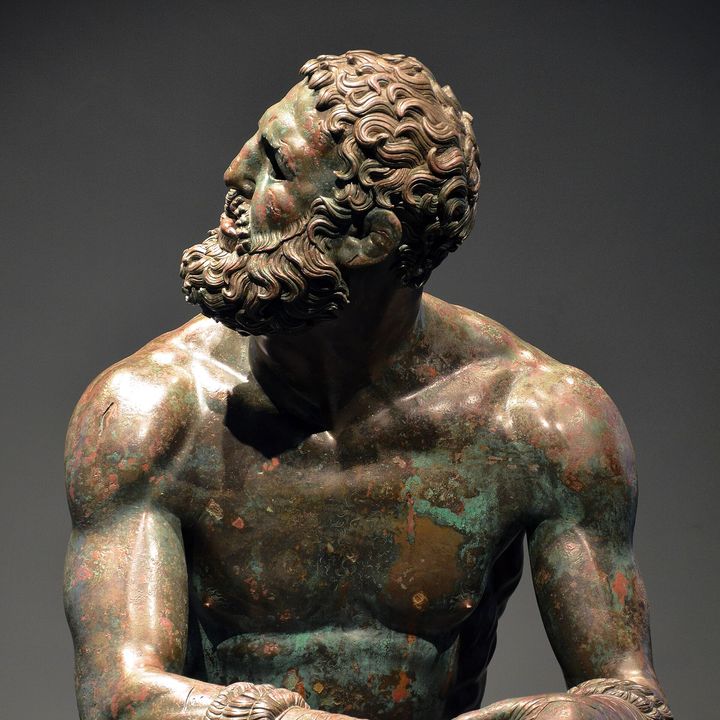
“Ah thou wert not quick enough, Myron, in thy casting; but the bronze grew solid before thou hadst cast in a soul.” - "On the Heifer of Myron", author unknown, Greek Anthology
On this day, October 6:
105 BC: Two quarreling Roman commanders, the consul Mallius Maximus and the proconsul Caepio, camped on opposite banks of the Rhône, are destroyed by the Cimbri and Teutones at Arausio, now Orange in Provence. It was Rome's worst defeat since Cannae, and it cleared the way for Marius and his professional army.
1536: William Tyndale, who translated the New Testament into English from the Greek, is strangled and burned at Vilvoorde, near Brussels. His last words, according to John Foxe, were a prayer that God would open the King of England's eyes.
Day 29 of 365 · Pause · Unsubscribe
A five-minute story from history each morning. It's free and ends after a year.